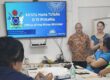
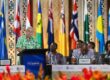
Prime Minister and Minister for Police, the Honourable Mark Brown concluded his participation in the inaugural Pacific Police Ministers Meeting, convened on the margins of the Pacific Transnational Crime Summit 2026, in Momi Bay, Fiji on Tuesday 19 May.
Co-hosted by the Government of Fiji and the Australian Federal Police under the theme “Connected by Ocean, United in the Fight,” the meeting brought together Police Ministers and Commissioners of Police from across the Pacific to agree shared positions on regional policing cooperation, the transnational crime landscape, drug harm, and a Pacific-led maritime security response.
Reaffirming the importance of strong cross-agency alignment and coordination to meet the emerging peace and security threats of the region, the Prime Minister led a Cook Islands delegation comprising the Police Commissioner, the Chief of Staff of the Office of the Prime Minister, the Secretary of Marine Resources, and the Acting Cook Islands High Commissioner to Fiji.
In his opening remarks at the meeting, the Prime Minister contextualised the Cook Islands operating reality: fifteen islands dispersed across 1.8 million square kilometres of ocean, with limited patrol capacity and communities that cannot absorb the consequences of an inadequate regional response.
“The Pacific is not backdrop for us, it is our road network, our border, and our inheritance. It is also a pathway that transnational crime is using without our permission,” the Prime Minister stated.
On the evolving regional policing architecture, including the Pacific Chiefs of Police organisation, the Pacific Policing Initiative (PPI) endorsed by PIF Leaders in Tonga, and an emerging proposal to bring more unity to Police Governance through structural reform opportunities, the Prime Minister called for these initiatives to be clearly situated within the Leaders-endorsed peace and security framework under the 2050 Strategy, rather than developed in parallel to existing governance structures.
The Prime Minister also emphasised that security partnerships with external partners must remain grounded in Pacific-defined principles, with sovereignty central, and with clear political backing for Police Chiefs navigating increasingly complex geopolitical environments.
In a frank intervention on drug harm and the growing methamphetamine threat across the Pacific, the Prime Minister drew on the evidence presented from Southeast Asia, where enforcement-first approaches produced devastating public health consequences to make the case for a prevention-led strategy tailored to Pacific realities.
“Methamphetamine has arrived in our communities, and drawing on the tragic experiences of regional and international neighbours, we know what happens next if we do not act carefully,” the Prime Minister said.
The Cook Islands Government has consistently maintained that enforcement resources should target criminal networks and supply chains, not users, who are themselves victims of those networks. The Prime Minister also called on regional protocols to accommodate community-based and traditional approaches to harm reduction, noting that frameworks designed for larger health systems will not automatically work in remote island communities such as Penrhyn or Pukapuka.
“We know that drug trafficking vessels transit the Pacific. We’ve seen the intelligence. But turning fragments of information into an interdiction, in the right place at the right time, consistently and safely, requires a level of coordination, information access and regional support that’s never existed before,” said Prime Minister Brown.
“For that reason, we believe it is in our national and regional security interests to support regional maritime intelligence interdiction uplift. At the same time, more assets in the water are only part of the answer. Combating transnational crime is also about leadership and tackling corruption wherever it undermines enforcement and public trust.”
The Prime Minister’s participation in this meeting forms part of a broader whole-of-government approach to peace and security threats facing the Cook Islands. In recent weeks alone, Cook Islands Ministers have engaged in two separate ministerial meetings on the emerging global fuel and energy security crisis, and the Pacific Foreign Ministers’ meeting convening at the end of this week will address the operationalisation of the Biketawa Declaration.
These parallel tracks reflect a deliberate government posture: that the security challenges facing the Cook Islands, whether transnational crime, maritime threats, drug harm, or energy vulnerability, require coordinated political and organisational leadership across multiple fronts simultaneously.
The Prime Minister’s regional engagement is matched by domestic legislative delivery. This week, the Honourable Tingika Elikana, Minister of Foreign Affairs and Immigration, introduces the Cybercrime Legislation Amendment Bill 2026 to Parliament for its first reading.
The Bill creates new offences for cyber-dependent and cyber-enabled crime, strengthens protections for children online, modernises Police search powers and rules of evidence, and aligns the Cook Islands with international best practice consistent with the Budapest Convention on Cybercrime. It delivers on the eighth pillar of the National Security Policy and is the first short-term priority of the Cook Islands Cyber Security Policy 2024.
The next iteration of the National Security Policy 2026 – 2030, a National Security Bill and a Privacy Bill are also in development, forming a coherent legislative foundation for the security, safety and trust of Cook Islanders in an increasingly inter-connected world.
The Prime Minister has directed relevant agencies to ensure that outcomes from the Fiji meeting are followed through at the national level, to enhance interagency collaboration, information sharing, and capability development including mobilising technology and assets. Ensuring the Cook Islands remains a peaceful and secure society is at the core of these efforts.
The Cook Islands remains actively engaged as regional processes move toward the next Leaders’ meeting in Palau in August 2026, and welcomes the support of 2026 co-hosts Australia and Fiji for the Cook Islands to host the next Police Ministers Meeting in the Cook Islands, in 2027, as affirmation of the importance of an inclusive approach to regional peace and addressing transnational security threats and the particular vulnerabilities of smaller island states.