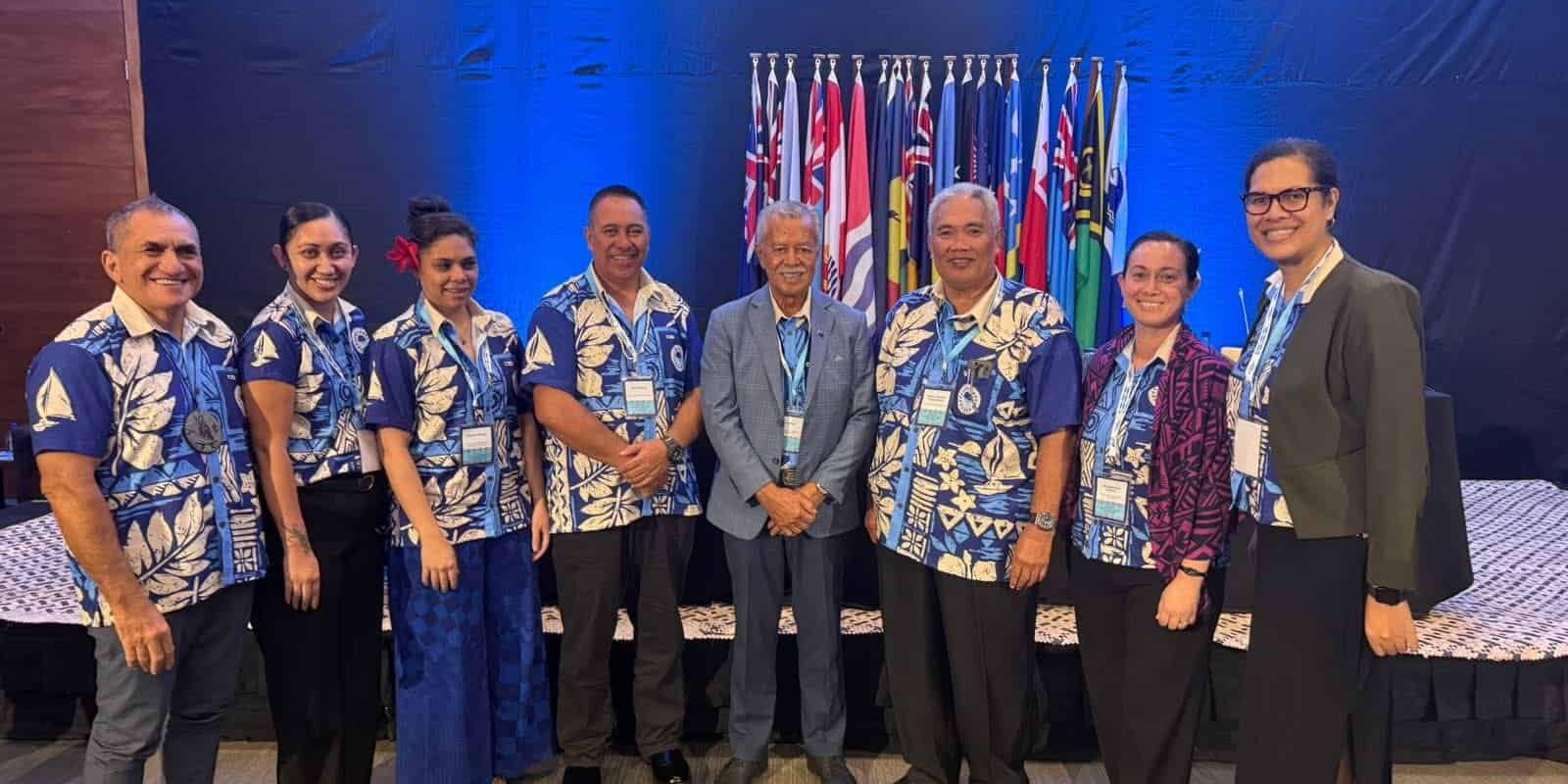
The Cook Islands delegation has concluded its participation in the Pacific Peace and Security Dialogue 2026, held in Suva, Fiji from 15 to 17 June, with the Minister of Foreign Affairs and Immigration and Minister for Marine Resources, Hon. Tingika Elikana, leading a whole-of-government delegation that featured prominently across all three days of the programme.
Coordinated by the Office of the Prime Minister (OPM), the delegation brought together the Chief of Staff and the National Security Director of OPM, the Secretary of Health, the Acting Cook Islands High Commissioner to Fiji, and officials from the Cook Islands Police Service and Customs Service. The breadth of agencies represented reflects the maturing of the Cook Islands whole-of-government national security system, built under the National Sustainable Development Agenda 2020+ (NSDA 2020+) and the Cook Islands National Security Policy 2023–2026, with OPM as administrator of the Policy and chair of the National Security Committee, continuing to lead cross-agency coordination on the country’s behalf.
Minister Elikana joined Pacific counterparts on the Dialogue’s “Leaders on Economic Security” panel on the opening day, arguing that economic resilience for small island states cannot be separated from institutional architecture. Minister Elikana pointed to the Cook Islands coordinated, interagency response to the ongoing global fuel crisis as evidence that pre-positioned planning, rather than ad hoc reaction, is what preserves stability under pressure, and called for regional energy cooperation that builds Pacific-led capability rather than new forms of external dependency.
Reflecting of the Leaders Panel, Minister Elikana noted that “For the Cook Islands, economic resilience and security are structurally linked. Our graduation from official development assistance eligibility, despite the vulnerabilities of a small, dispersed economy, has created a financing gap that grey zone actors are able to actively target. Regional economic security frameworks need to be calibrated for the full spectrum of Forum members, including those of us who have graduated, and are soon to graduate, from development assistance, if we’re to minimise these risks.”
The Dialogue builds directly on the ground the Cook Islands established at the inaugural Pacific Police Ministers Meeting in Momi Bay in May, where Prime Minister and Minister of Police Hon. Mark Brown called for a prevention-led, intelligence-driven response to the Pacific’s growing methamphetamine threat and secured the support of co-hosts Australia and Fiji for the Cook Islands to host the next Pacific Police Ministers Meeting in 2027. That meeting also tracked closely with the Cook Islands’ domestic delivery on the eighth pillar of the National Security Policy, including the introduction of the Cybercrime Legislation Amendment Bill 2026 and continued work on the next National Security Policy 2026–2030, a National Security Bill and a Privacy Bill.
On transnational organised crime, Secretary of Health Mr Bob Williams represented the Cook Islands on the “Regional and Community Cooperation to Fight Transnational Organised Crime” panel, encouraging national security practitioners and policy makers to work across agency boundaries. “We all know from COVID-19 that health alone cannot work in isolation, and so it is with regard to transnational organized crime,” said Secretary Williams. “Drug operations and smugglers rarely exploit healthy, resilient communities. They infiltrate communities where there is economic and social stress, weak health system and law enforcement architecture, or a fragmented national response system.”
Reflecting on the three days, Chief of Staff Ms Karopaerangi Ngatoko said the Dialogue had reinforced a message the Cook Islands has carried across every recent regional security forum. “What this week confirmed is that Pacific security is integrated – you cannot separate national security from economic resilience, from energy, from health, from transnational crime, from land and mobility. These are all facets of the same expansive definition of national security endorsed by our Forum Leaders through the Boe Declaration of 2018” Ms Ngatoko said. “The Cook Islands is building that integration nationally, through the strengthening of our statute book, streamlining of clear security architecture and governance, and genuine cross-sectoral coordination.”
Ms Ngatoko noted that the Dialogue had also surfaced specific gaps for the Cook Islands to pursue regionally, among them, strengthening the health-security interface in transnational crime response, building small state capacity for futures-oriented national security planning, and securing genuine Pacific agency in energy transition governance. “We are taking those gaps back into our domestic work, and into the Regional Peace and Security Action Plan 2026–2030, which we see as the vehicle for carrying this forward,” she said.
The Office of the Prime Minister will work with participating agencies to feed outcomes from the Dialogue into ongoing national security policy work, including development of the next iteration of the National Security Policy and the design of the National Security Bill and Privacy Bill, ensuring the momentum built across the Pacific Police Ministers Meeting and the Pacific Peace and Security Dialogue translates into concrete domestic delivery ahead of the Cook Islands’ hosting of the Joint Heads of Pacific Security Meeting, as well as the Pacific Police Ministers Meeting, in 2027.