“The Pacific energy transition is not a climate concession. It is an economic security strategy. The same investments that lower our emissions also lower our exposure to the next global shock.”
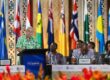
That was the message Prime Minister Mark Brown brought to fellow Governors at the Asian Development Bank’s 59th Annual meeting in Samarkand, Uzbekistan this week.
In his Governor’s Statement, the Prime Minister set out how the Cook Islands is responding to the global fuel crisis at home, and how the country is working with the Asian Development Bank (ADB) on financial solutions that strengthen security of supply for Pacific Island countries and fast-track the region’s renewable energy transition.
“The Cook Islands is working closely with the ADB on financial solutions that support security of supply for Pacific Island countries, and that fast-track our energy transition to renewables. This is good news for our Pa Enua solar farms, and it is good news for every Cook Islander who wants reliable, affordable, home-grown power,” the Prime Minister said.
While in Samarkand, the Prime Minister also acknowledged the conservation effort underway at home, and the work of the Energy Response Technical Working Group in coordinating supply, demand and communications across government, the visitor industry, and communities.
“Conservation is a real lever. Every litre saved is fuel for our hospital, our schools, our airports. Every choice to use a little less is a choice that connects directly to our renewable energy future,” the Prime Minister said.
The Prime Minister underscored that the Cook Islands’ engagement with the ADB is opening pathways to bring forward renewable energy investments, including solar generation, battery storage and grid upgrades that will reduce long-term reliance on shipped fuel across the Pa Enua.
In Samarkand, the Prime Minister welcomed the Asian Development Bank’s continued commitment to a differentiated approach for Pacific small island developing states under the Pacific Approach. He encouraged the Bank to scale up innovative financing instruments, blended finance, results-based mechanisms and climate-linked instruments and to consider the conversion of foreign currency debt into local currency for small economies with limited capacity to hedge currency risk.
“We are interested in how the ADB can support the scaling of practical, country-led solutions through tailored financing approaches that reduce upfront costs, crowd in private sector participation, and de-risk investments in small and remote markets,” Prime Minister Brown said.
“Concessional finance access for Pacific small island states should be preserved on the basis of vulnerability, not income status alone. Graduation thresholds were not designed for economies that can lose a year of gross domestic product in a single cyclone, or absorb a global energy shock with no domestic substitute.”
The Prime Minister also commended the ADB’s emerging work on critical minerals as “timely and forward-looking,” urged the active inclusion of Pacific small island developing states in that program, and acknowledged the recently released Value for Money in Procurement Framework agreed by multilateral development banks in April 2026. He underscored that the Cook Islands should remain eligible for grant-funded regional programs such as Correspondent Banking Relationships, recognising the structural realities of small, remote economies.
Prime Minister Brown closed by linking this moment back to the Cook Islands’ longer-term energy story.
“This is exactly why we are moving to renewable. We are already generating just over 30 percent of our electricity from renewables, and our goal is 60 percent by 2030. Every solar panel on a government building, every efficient appliance, every household that shifts its habits is part of that journey. We will use this period to push our renewable energy goals harder, not slower. When we come through this, and we will, we will come through it stronger, more self-reliant, and closer to the energy future our people deserve.”