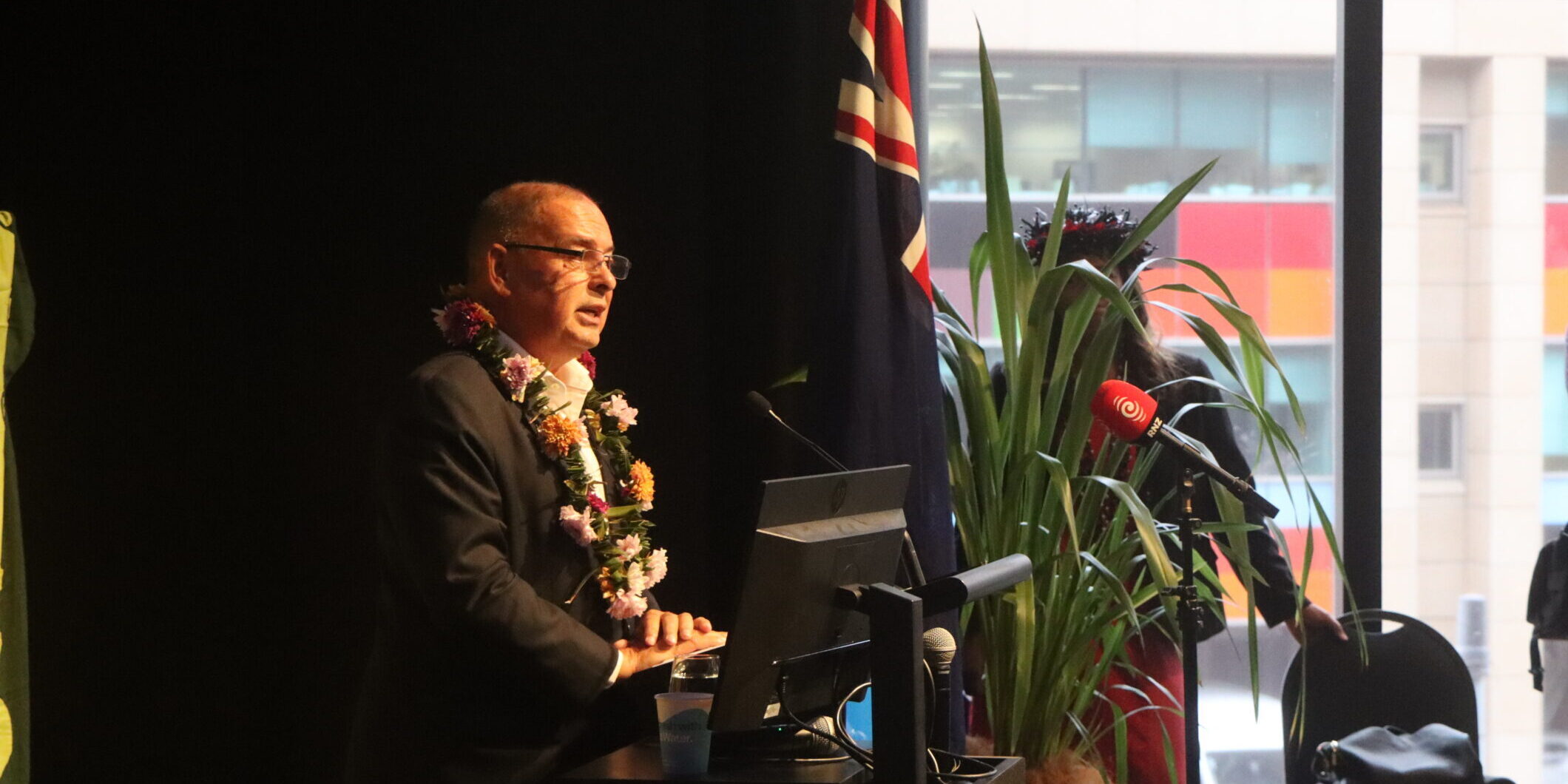
(Prime Minister’s address in Wellington on Wednesday 18 March 2026)
Ko toku papa tupuna
Kua ‘akamou’ia ki runga ite pito enua
Ko taku korero taito, kua ‘akairo ia ki runga i te va’anga rakau
Kia to’ito’i ia ki runga ite poaki maori,
E rau te tuatau
Kua kite oki au i toku turanga, e enua toku, e Avaiki toku
Iekoko
Kia orana tatou katoatoa I te aroa nui o te Atua
Distinguished guests, family, friends and partners thank you for your warm welcome here in Te Whanganui-a-Tara, Wellington.
I stand here today not only as Prime Minister of the Cook Islands, but as part of a wider Cook Islands family whose story spans oceans, generations, and borders.
This visit comes at an important time for our country and for our relationship with Aotearoa New Zealand. It is a moment to reflect and to look forward together with clarity and confidence.
From August 2025 to August 2026, the Cook Islands stands together as a nation, not just to celebrate a moment in time, but to honour a legacy.
Sixty years ago, our people made a bold and deliberate choice, to govern ourselves. To take responsibility for our future. To stand tall among the nations of the world, proud of who we are, where we come from, and where we are going.
We mark that journey under the theme: Kua kite au i toku turanga, e Avaiki toku. I know who I am, I have a homeland.
These are not just words. They are a declaration of identity. A reflection of belonging. A reminder that wherever we stand whether in Rarotonga, in Manihiki, in Wellington or Sydney, we carry with us a deep connection to our enua, to our people, and to our purpose.
We celebrate not just our achievements, but our identity, an identity grounded in faith and culture, shaped by history, and carried forward in our journey to statehood.
Central to our journey to statehood has been the compass at the centre of our navigation – our culture, our Peu Maori, and our Christian faith.
Te peu Māori is a living system of knowledge, values, and identity. It shapes how we lead. It strengthens how we relate to one another. And it is the foundation for how we build our nation.
Te Peu Māori – Our Way – has been tested by time. It has withstood the pressures of change, colonisation, migration, and modernisation. And yet it remains solid, the foundation upon which our culture has been built, and continues to grow. It is a system both ancient and adaptive, resilient and responsive. It is from this foundation that we draw strength as a people.
When we speak of resilience and navigation, we are also speaking of culture and faith. Because it is these central pillars of Cook Islands society that gives us grounding in times of change. It is culture that holds us steady when the path ahead is uncertain. And it is faith that gives us confidence to shape our future with clarity and care.
We as Cook Islanders must always reflect who we are as a people. We are taught to know where we come from, in order to know where we are going. This wisdom reminds us that our past is not a place we leave behind – it is the foundation we stand on. Our future is strongest when it is holds fast to the strength of our identity.
Providing the wind in our sails, are the contributions of our Cook Islands population at home, here in New Zealand, and beyond.
Over the past six decades, the Cook Islands population has expanded across oceans.
Our people have built lives across Aotearoa New Zealand, Australia, the Pacific, and further afield. Yet we are not scattered. We are connected by papa’anga, by values, and by a shared commitment to our homeland.
When Cook Islanders pursue opportunity abroad, we do not shrink as a nation. We expand.
Our diaspora strengthens both our country and the communities they serve. And nowhere is that more evident than here in Aotearoa New Zealand.
This visit is about listening to our people, strengthening those connections, and ensuring their voice continues to shape our national direction.
Because kua kite tatou i to tatou turanga, we know our place. And e Avaiki toku, we all have a homeland.
As any good navigator will attest, to be able to look forward, we must know where we have come from.
On the 4 August 1965, against a backdrop of the United Nations General Assembly adoption of the Declaration on the Granting of Independence to Colonial Countries and Peoples, and a related Resolution on self-determination, the Cook Islands, with New Zealand’s support, chose self-governance in free association.
Free association allows for the Cook Islands to maintain New Zealand citizenship, whilst at the same time making our own laws and administering our own domestic and foreign affairs.
In 1965, the Cook Islands embarked on a path of self-governance, embracing the responsibility to chart our own destiny.
The governance model we chose was shaped by our faith, our culture and our community. From the beginning, we have chartered our development path with care, conviction, and a commitment to doing what is right for our people.
In 1965, we were a nation defined by 15 islands with a total land surface-area of just 250 square kilometres. Today, the Cook Islands Exclusive Economic Zone spans nearly 2 million square kilometres of ocean – a surface-area of comparable size to the landmasses of Mexico or Saudi Arabia, and 4.5 times the size of the state of California.
The Cook Islands modern identity is no longer defined by the projections of large powers that characterise us as “small” – we are a large ocean state growing in influence, underpinned by the work of generations of Cook Islanders both within our Pacific region and beyond.
Over these six decades, we’ve achieved milestones that affirm and reaffirm, our identity and our agency. From formally establishing our maritime boundaries and the establishment of our Marae Moana, to the development of our economy to the extent that we graduated to high-income status in 2020, through to our increasing profile and engagement on the international stage, our voyage to statehood reflects our agency, resilience, and vision.
We acknowledge the pioneers who laid the foundations and the collective efforts that have brought us to where we are today.
In reflecting on where we’ve come from, we must also acknowledge those who have been alongside us, in our vaka, on this journey.
In 1965, we chose self-governance in free association with Aotearoa New Zealand. This choice was grounded in our shared papa’anga or ancestral ties, our shared values, and our vision for self-determination.
History shows that our ancestors possessed the vision and excellence required to settle Te Moana Nui o Kiva, grounded always in a pragmatic approach to both navigation and governance.
This pragmatism, defined by the practical weighing up of choices against projected outcomes can be seen in the choice made by our tupuna to take the first step in our journey to statehood, based on the economic and social realities of Cook Islands society in 1965.
Over time, our desire to pursue our own policies and interests have been reflected in our growing participation on the international stage, as well as through the evolution of conventions that give effect to our modern bilateral relationship with Aotearoa New Zealand.
This relationship has delivered mutual benefits not only between Aotearoa New Zealand and the Cook Islands, but also for our Realm of New Zealand.
Since the first waves of migration from the Pacific to support New Zealand’s primary industries in the 1950’s, Cook Islanders have shown resilience and hard work, often at the forefront of New Zealand’s economic and social development.
Today, the Cook Islands diaspora is a vital part of New Zealand’s diverse society, with over 90,000 Cook Islanders calling Aotearoa New Zealand home. This community has made significant contributions to key sectors including healthcare, education, business, sports, and the arts, driving positive change and growth in the country. Many have also excelled in leadership roles, becoming trailblazers in both the public and private sectors.
Indeed, our contributions to the peace and security of our Realm of New Zealand are also worthy of mentioning. History shows that though we were one of the smallest territories in the British Empire at the time, more than 500 Cook Islands men volunteered during World War I, a remarkable commitment from a nation far removed from the actual conflict. Our men served not for reward, but for duty. That spirit of contribution and shared sacrifice defines the ANZAC legacy across Australia, New Zealand, and the Pacific, and it continues to shape our values as a nation. Our men stood alongside their brothers in arms in foreign fields, and today, we continue to stand together as partners committed to peace, democracy, and regional solidarity.
Like any relationship that has been in existence for six decades, there are moments that call for reflection. There are times when we must pause and consider whether the conventions and evolved understandings between our freely associated states remain aligned.
We find ourselves in such a moment, during the 60th year of the Cook Islands self-governance in free association with New Zealand. I see our relationship as one grounded in enduring kinship – like members of a family who continue to care deeply for one another, even as each has grown and charted their own path. Maturity shouldn’t change our bond; it should strengthen the abiding care and commitment we hold for each other’s wellbeing.
We approach our special relationship with Aotearoa New Zealand with care and confidence, and we do so as a self-governing nation, proud of our identity, and fully aware of our responsibilities.
Most importantly, we do so with our people at the centre. Their wellbeing, their voice, and their future guide every step we take.
We value our relationship with New Zealand deeply. And we will continue to invest in it with honesty, respect, and purpose. Our focus is simple: to ensure this relationship continues to evolve in a way that reflects who we are today and supports where we are going together.
As we turn our focus towards the horizon, we must do so with clear eyes and clear hearts, acknowledging the importance of diverse international partnerships for our journey ahead.
This year, we find ourselves navigating increasingly complex development needs within a landscape of rapidly shifting geopolitics.
Over the past 60 years, the Cook Islands has joined a wide number of regional and international organisations in order to promote and protect our interests. Today, we are a member of most Pacific regional organisations and enjoy full membership of the FAO, ICAO, UNESCO, WHO and other UN specialised agencies.
The United Nations recognised the full treaty-making capacity of the Cook Islands in 1992 and the Cook Islands today is party in its own right to well over a hundred multilateral disarmament, environmental, fisheries, human rights and other internationally binding treaties.
Alongside our growing multilateral and regional engagement, our bilateral engagement has also grown. Since 1965, we have established formal diplomatic relations with over 70 States and I acknowledge many of them are in this room tonight.
As a large ocean state, we are a Pacific nation with a global voice. And we will use that voice to lead with purpose.
From our earliest days of self-governance, under Premier Albert Henry, we have stood with our region. We have contributed to peace, advanced multilateral cooperation, and advocated for the rights and needs of Pacific peoples.
Since 1965, we have exercised our international voice with clarity and courage. We were one of 7 founding members of the Pacific Islands Forum. We have joined global institutions. We have negotiated maritime boundaries. We have championed nuclear disarmament and ocean protection. The Treaty of Rarotonga, signed 40 years ago in our capital, is a lasting testament to our values and our vision for a peaceful Pacific.
Our foreign policy is grounded in principle. We engage with the world based on mutual respect and shared responsibility. Our international agreements are aligned with our Constitution, our laws, and our development goals.
Our voice matters. Not because of our population size, but because of what we represent. A nation that holds fast to its identity while engaging with the world on its own terms.
This is what it means to be a Pacific nation with a global voice. We don’t need to speak the loudest, because we speak with purpose. And increasingly the world listens.
The story of our development journey isn’t complete without reflecting on the ama that has held our vaka steady over the past six decades – our economy.
In the early years, we laid the groundwork for our development with what limited resources were available to us at the time – investing in essential services like roads, schools, and healthcare, whilst also leaning on the generous support of our development partners.
As challenges arose, particularly during the mid-1990’s, we responded with courage and reform, adapting and strengthening our public financial management systems and ensuring every dollar was used wisely.
Though challenging, these were important lessons that helped to ensure that today the Cook Islands have some of the most robust and transparent systems and processes for high-level governance, oversight and implementation of activities with development partners in the entire region.
Adapting from the harsh but necessary reforms of the 1990’s, we now have strong technical expertise and are regional leaders in sustainable tourism management, seabed minerals, fisheries, public financial management and social inclusion, to name but a few of our strengths.
For decades, the tourism sector has been the backbone of our economy. It has created jobs, supported families, and brought opportunity to our shores.
Before COVID-19, tourism accounted for around 70 per cent of GDP and roughly two-thirds of employment. In 2019, we welcomed over 170,000 visitors. In 2021 however, arrivals fell by more than 90 per cent. Government revenue dropped sharply at the same time that demand for public support surged. Within months, a healthy fiscal position tightened into conservative management that prioritized continuation of essential services and keeping our businesses afloat.
That experience forced a reset. It exposed how vulnerable micro-economies are to external shocks we do not control: pandemics, border closures, global recessions, fuel price spikes. These shocks are even more acute when a micro-economy is heavily reliant on a single sector for growth and development.
Resilience, for us, now means building a broader economic base with multiple, reinforcing pillars of growth.
This is what resilience looks like. Not just surviving hardship, but emerging stronger. Choosing reform over retreat. Choosing long-term value over short-term comfort.
None of this progress has come easily. And none of it has come by chance.
It has come through careful decisions. Through investment in our people. Through confidence in our decision-making. Through a vision that is clear: to build a Cook Islands economy that is future-ready, fair, and firmly grounded in our values.
As we mark 60 years of self-governance, we honour those who paved the way for this moment. And we look forward, with belief in our young people, in our institutions, and in the capacity of our nation to chart its own course.
Tonight, we have honoured our past. We have acknowledged our journey. And now, we navigate our vaka towards the horizon.
The next 60 years of the Cook Islands story will be written by a new generation, a generation that is digitally fluent, globally aware, and firmly grounded in their identity.
We have laid the foundation. A resilient economy with eyes on diversification. A culture that is vibrant, evolving, and central to our development. A people who are united across oceans, confident in who they are and where they belong.
Now is the time to build on that foundation with clarity and purpose.
Tourism will remain a cornerstone of our economy. It is deeply connected to how we share our culture, language and values with the world. But COVID showed us clearly that dependence on one sector leaves our communities and economy exposed.
Our economic development strategy is therefore about complementing tourism, not replacing it.
We are focused on building new sectors that strengthen sovereignty, create skilled and better-paid jobs for Cook Islanders, and provide more predictable public revenue.
At the same time, we are clear that economic growth that erodes culture or weakens community cohesion is not success for us. Development must strengthen who we are as Cook Islanders, not dilute it.
While we pursue all avenues to diversify our economy, it must be noted that diversification will fail if it is built on fragile foundations. Infrastructure and disaster resilience are therefore central to our economic strategy and diversification objectives.
Like others in the Pacific, the Cook Islands is highly exposed to climate risk. Major tropical cyclones have, in the past, caused significant damage.
Critical assets such as ports, airports, power generation, water systems, and telecommunications are also vulnerable to the impacts of climate change.
Our resilience priorities are therefore practical and urgent:
- Climate-resilient transport and ports: strengthening wharves and airports to ensure continuity of trade, tourism, emergency response and supply chains during extreme weather events.
- Energy security and resilience: expanding renewable energy generation and battery storage to reduce reliance on imported diesel, which currently accounts for a large share of energy costs and is highly vulnerable to global price volatility and shipping disruptions.
- Digital infrastructure and redundancy: investing in resilient telecommunications and data systems so that government services, regulatory oversight, disaster coordination and financial systems remain operational during crises.
- Water and sanitation resilience: upgrading water security systems to withstand droughts and contamination following extreme weather events.
In an age of increasingly severe climatic events, these investments are economic risk management. Every dollar spent strengthening resilience reduces future disaster recovery costs and shortens recovery time for businesses and households.
For investors and partners, our priorities are clear and pragmatic:
- Science and technology partnerships that strengthen environmental monitoring, build our knowledge base, and reaffirm our prioritisation of data to inform decision-making.
- Resilient infrastructure investment, including ports, energy systems and digital platforms that support diversified economic activity, public sector efficiencies, and regulatory transparency.
- Financing aligned with high environmental, social and governance standards that ensure long-term sovereign benefit, and transparent revenue management.
- Skills and workforce development, so Cook Islanders can move into high-value technical, regulatory, environmental science and engineering roles, rather than remaining on the margins of new industries.
Our broader economic strategy is straightforward in principle, even if complex in execution:
- Diversify intelligently.
- Protect our environment rigorously.
- Preserve our culture proudly.
- Build partnerships grounded in trust and confidence.
For the Cook Islands, economic resilience means ensuring that future shocks (pandemics, climate impacts, market disruptions) do not again threaten the stability of our nation.
Cultural sustainability means ensuring that development strengthens, rather than weakens, the social fabric that has carried our people across generations of change.
We welcome partnerships that respect these principles. And we are ready to work with partners who share a long-term vision for resilience, responsibility, and shared prosperity in the Pacific.
On confirming our choice of self-governance in free-association with New Zealand in 1965, our forebear Papa Arapati said “Let us begin”. Tonight I say, “Let us go forward”.
Let us continue to strengthen our partnerships with Aotearoa New Zealand, with our region, and with the world, in a way that reflects who we are and where we are heading. Partnerships built on respect. On mutual interests. And on shared vision.
Let us keep investing in our people, in our infrastructure, and in our islands from the far north through to the south, because every one of our communities’ matters, and every island holds a piece of our future.
And, let us keep walking forward as one nation. A nation that knows its place. A nation that has a homeland. A nation that carries with it the hopes of those who came before us and the dreams of those yet to come.
Kua kite au i toku turanga. E Avaiki toku.
May we carry this truth with us as we voyage into the next 60 years and beyond.
Kia orana e kia manuia.