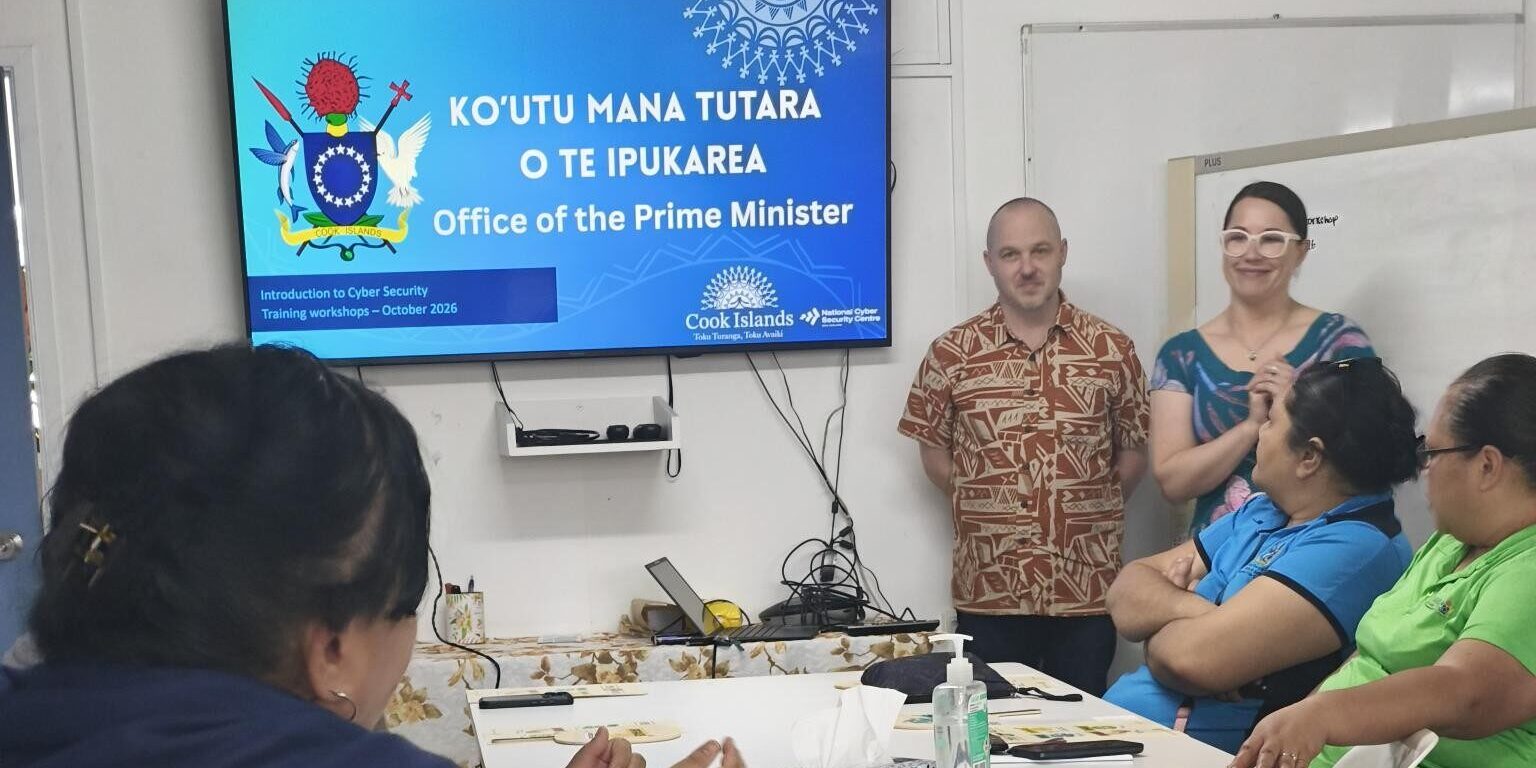
The Office of the Prime Minister (OPM), working with the National Cyber Security Centre (NCSC) of New Zealand, delivered cyber safety awareness training for the Cook Islands public service last week.
On Monday 5 October, Heads of Ministries and Agencies and agency IT leads took part in dedicated training sessions. Drop-in sessions for public servants from across Government followed, from Tuesday to Thursday morning. The sessions were well attended, with participation from 22 agencies and 142 officials.
The training responds to a rise in phishing and other scams targeting public servants. These scams are becoming harder to spot as bad actors use new tools, including AI, to make them more convincing. The one-hour workshops were designed for non-technical audiences. They covered current threats in the Cook Islands and the Pacific, real examples of phishing emails and scams, and simple steps people can take to stay safe.
“Technical safeguards are important, but cyber incidents often begin when someone unknowingly responds to a fraudulent email, link or request. Awareness and vigilance remain among our most effective defences,” said Karopaerangi Ngatoko, Chief of Staff, Office of the Prime Minister. “Participants left with practical steps they can use immediately, at work and at home.”
The training puts the Cook Islands Cyber Security Policy 2024 into practice. It supports the Policy’s commitment to strengthen Government’s defences, and its commitment to give our people the skills to stay safe online.
It is also an early step in a wider uplift led by OPM ICT. In line with the Policy and Te Ara Akapapa’anga Nui, OPM’s ICT division is working with the New Zealand Ministry of Foreign Affairs and Trade (MFAT) on a Cyber Uplift Programme, due to begin before the end of 2026. The Programme is expected to support:
- a Cook Islands National Cyber Security Centre;
- an assessment of what government needs to modernize its ICT infrastructure; and
- a stronger cyber security workforce.
The Centre is expected to monitor national cyber threats and respond to incidents, set security standards and assurance for government ICT, and help protect critical national infrastructure. It will also build awareness and capability across government and the wider community, and liaise with regional and international partners.
OPM acknowledges the NCSC New Zealand and the New Zealand Ministry of Foreign Affairs and Trade (MFAT). Their support made the training possible, and they continue to assist with scoping and designing the Cook Islands NCSC.
As the Policy states, building cyber resilience is a shared responsibility that cannot be achieved by one group alone. Government, businesses, churches, traditional leaders, community groups, families and individuals all have a part to play. These simple habits help keep us safe:
- Pause before you click. Be wary of urgent requests, even when they appear to come from someone you know or someone senior. Check by calling them or using another channel to verify whether the request is legitimate.
- Protect your accounts. Use strong, unique passwords or passphrases, and turn on multi-factor authentication.
- Keep devices up to date. Install software and app updates promptly.
- Guard personal information. Never share passwords, codes or bank details. Think carefully about what you post on social media.
- Speak up. Report suspicious messages to your IT team or agency, and talk to your family and friends about scams.