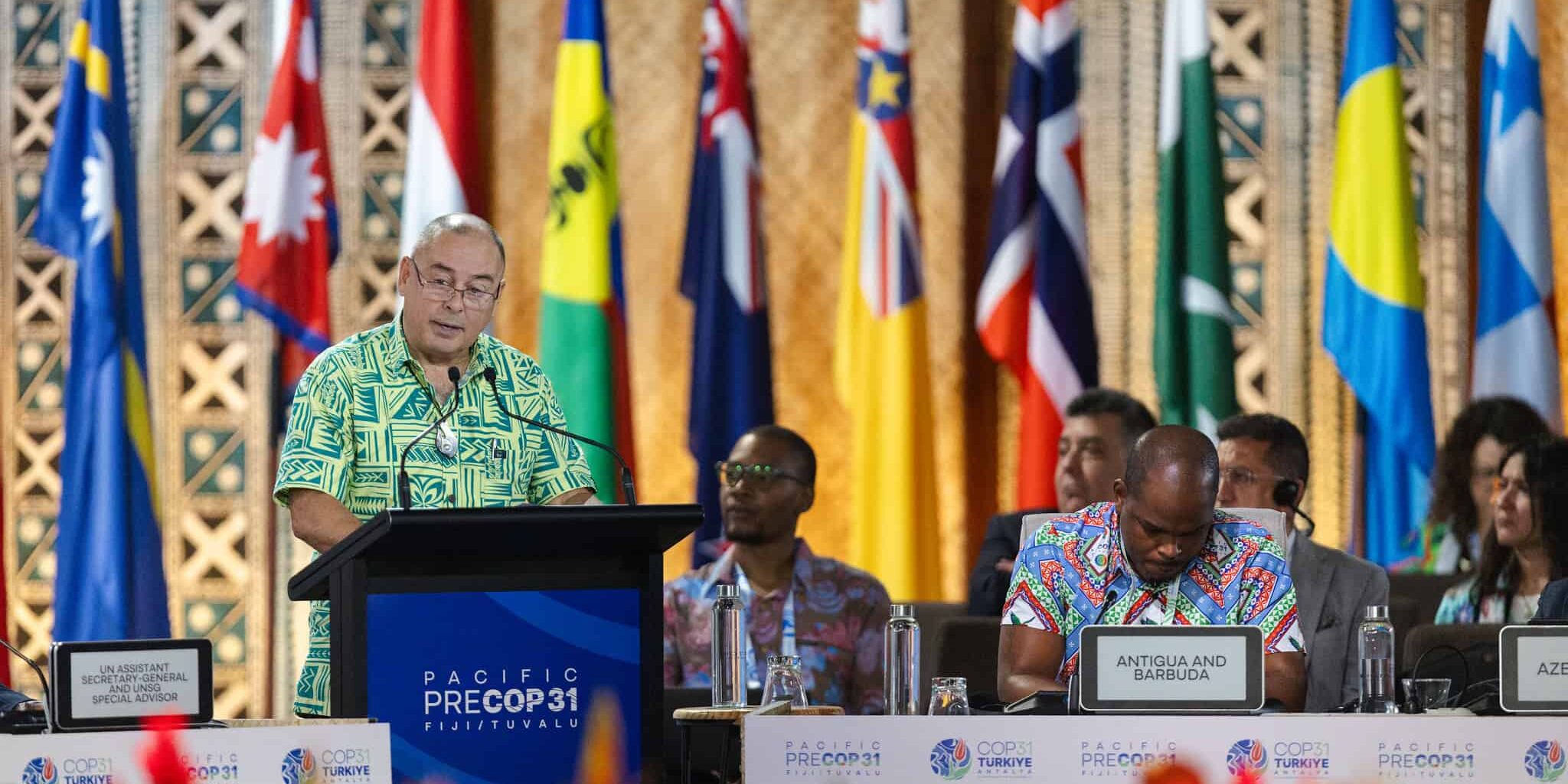
Prime Minister Statement, delivered in Fiji on Thursday 8 October
I’ve served as Finance Minister of my country since 2010. I have been a GCF Champion during its last replenishment cycle, a PRF Champion since its inception, and a Pacific Islands Forum Political Champion for Climate Finance for several terms. I can speak from experience.
So I can say this plainly: we are stuck in a painful loop, and somehow we keep finding increasingly creative ways to arrive back at exactly the same conversation.
I say this with respect. We know the needs. We know the barriers. We know that our people cannot afford to wait. Will there be change when PreCOP concludes? That has to be the starting point today.
Minister Bowen, vinaka vaka levu, meitaki maata for proposing this Climate Finance Access Plan. Next year, I hope we will be discussing what changed, rather than what to call another initiative.
Because let us be direct about what access means.
A fund can report that money is available. A government can report that an application is progressing. Both statements can be true, while a community remains unprotected.
Somewhere between the announcement and the shoreline, our understanding of success has parted company.
And in our small nations, that gap is where decisions become make-or-break. Because we must decide what can wait. Which infrastructure we can protect. And which needs we can meet from our own budget, while finance works its way through somebody else’s system.
Delay does not remove the cost. It transfers it. To our budgets. To our public servants. To families who pay for time they did not waste.
Yet when we discuss financial risk, how often do we count the risk we transfer to them? We scrutinise the consequences of approving finance. We should scrutinise the consequences of delaying it just as seriously.
That is the change we’ve sought for decades. From the Global Environment Facility to today, the architecture, access rules and accountability have all evolved. Yet somehow, the problem has survived them all.
Small Island States are not asking to be excused from accountability. We are asking for a system in which everybody is accountable for the part they control.
Our governments control the quality of our proposals and how we use the funds. Providers control their requirements, their decisions and the time those decisions take.
Accountability should follow that responsibility.
So, to return to this proposed Plan. If 1.5 degrees is a serious commitment, then access to finance must be too. This Plan must pass three simple tests:
First, put a clock on access.
Every participating provider should publish decision timeframes, explain delays, and report how long it takes to complete an application and reach the first disbursement.
Count the applications still waiting, not only those approved.
Second, stop making small administrations prove the same things repeatedly.
Where institutions have already assessed our national systems, recognise those assessments wherever possible. Agree common requirements. Fund the capacity needed to meet them.
We cannot strengthen public institutions by keeping their best people permanently occupied with applications.
Third, finance the way our islands actually function.
A small population spread across distant islands does not mean a small cost of delivery.
Allow countries to bring connected investments into a long-term national programme. Make funding predictable. Match its terms to our circumstances, including grant finance where additional debt would torpedo the resilience we are trying to build.
These are practical choices. They require institutions to change, not merely countries to adapt to them. Because adaptation has limits, even in governance.
If this proposed Plan is to make a difference, the commitments must come from those who control access.
At COP31, tell us what you will change. A year later, show us what changed.
We will report on our delivery. We ask you to report on yours.
As stated in this very room two nights ago: we saw in Tuvalu what leadership and investment can achieve together. What we cannot and should not do is organise our people’s safety around an indefinite wait.
Let this meeting be the end of asking Small Island Developing States to explain, once again, why access is difficult. Today, we start asking those who control the funds what they have done to make access easier.
Let us begin. Meitaki maata.